


VTuber Character Design: Why Identity Matters More Than Technology

Most conversations about VTubers focus on the technical side: which rigging software is best, how many tracking points a model supports, whether the physics on the hair look natural. These things matter, but they're not what makes a VTuber actually work.
The VTubers that build real audiences, sustain engagement over years, and eventually become recognizable beyond their platform share something that has nothing to do with their technical specifications. They have a clear identity. Viewers know who the character is, what they're like, and why they're worth following, within minutes of watching for the first time.

That identity doesn't come from rigging. It comes from design decisions made long before the model is ever built. And understanding what those decisions are is the difference between a technically impressive model that never finds its audience and a character that people genuinely connect with.
Personality comes before the model
The most common mistake in VTuber development, from solo creators and agencies alike, is starting with visual design before the character's personality is defined.
It seems logical to start with art. You want to see what the character looks like. But visual design made without a clear personality brief almost always produces something generic, an appealing anime character with no particular identity. The design has nowhere to anchor itself.
Before any concept sketches begin, a VTuber character needs at least a basic personality framework: what is their core trait, what is their relationship with their audience, what topics or content areas are genuinely native to who they are, and what is the emotional register of their presence. Are they warm, chaotic, calm, comedic, intense?
These decisions shape everything downstream. A high-energy chaotic character needs a design with sharper shapes, bolder colors, and more dynamic hair and accessories. A calm, intellectual character needs something more restrained. The personality brief is what tells the designer which direction to go — and without it, even talented artists are guessing.
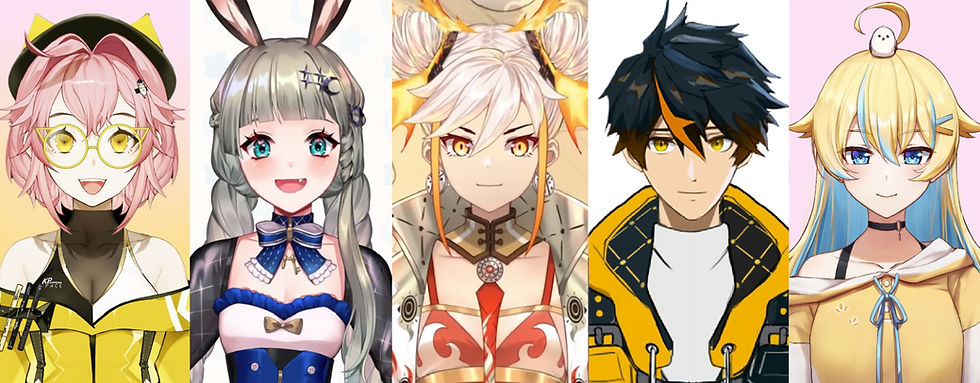
Visual cohesion across every asset
A VTuber character doesn't live only in their Live2D model. They exist across stream overlays, waiting screens, social media graphics, thumbnail art, merchandise, and promotional materials. Every one of these touchpoints is an opportunity to reinforce identity, or to undermine it.
Visual cohesion means all of these assets feel like they belong to the same character. Same color palette, same design motifs, same general energy. When a viewer sees a thumbnail, a Twitter banner, and a stream layout that all feel consistent, the character starts to feel like a real, established presence rather than a work in progress.
This requires planning at the design stage, not after the model is delivered. The color palette, the signature design elements, whether that's a specific accessory, a recurring motif, or a distinctive silhouette, all need to be defined as part of the original character design, so they can be carried consistently across every asset that follows.
Expressive rigging is part of the character
Rigging is often treated as a purely technical task, the step that makes the model move. But the expressiveness of a rig is inseparable from character identity.
A VTuber whose model can only produce a narrow range of expressions will always feel flat, regardless of how good the illustration is. Viewers read emotional states through facial movement and body language. A character that can't convey surprise, frustration, concentration, or genuine laughter is missing the tools that make a live performance feel real.
This means expression design needs to be part of the character brief, not an afterthought. How many emotional states should the character be able to display? What does their laugh look like? What's their default resting expression — and does it communicate the right personality? These questions should be answered during the design phase, before the rigger begins their work, so the facial structure and part separation are built to support the full range of expressions the character needs.
Designing for long-term scalability
A VTuber character that's only designed for their debut is already behind. Successful characters grow, they get new outfits, seasonal costumes, updated assets, and eventually merchandise. A design that wasn't built with this in mind becomes harder and more expensive to expand over time.
Scalability in character design means a few specific things:
Modular design elements: accessories and outfit components that can be swapped or updated without redesigning the base character.
A defined design system: clear rules for what colors, shapes, and motifs belong to this character, so new assets made later still feel consistent with the original.
Cross-format adaptability: a silhouette and design that works whether it's rendered as a full Live2D model, a chibi version, a sticker pack, or a print on merchandise.
Characters built with these considerations from the start can grow with their creator. Characters built only for debut often require expensive redesigns when the creator's audience and ambitions outgrow the original model.
What this looks like in practice
At KP Comics Studios, VTuber projects begin with character development, not model production. That means defining personality, visual identity, and brand direction before concept art is finalized, so every downstream decision has somewhere to anchor.

If you're developing a VTuber character and want to build identity into the design from the start, get in touch with us. We respond in English, Japanese, and Thai within 24–48 hours.
Posted by KP Comics Studios — Bangkok-based anime-style production, serving clients in Japan, the US, Singapore, Korea, and Europe since 2015.

Comments