


Commissioning TCG Card Art: A Comprehensive Guide for Independent Creators

Updated: Aug 10
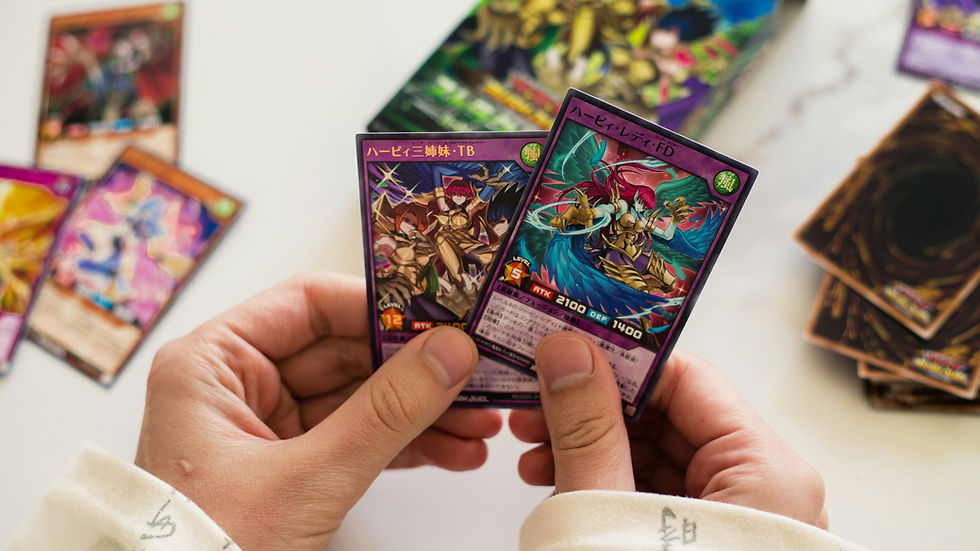
Trading card games (TCGs) have never been more accessible to independent creators. Print-on-demand services, Kickstarter campaigns, and digital platforms like Steam have made it possible to launch a TCG without a publisher. However, one challenge remains: commissioning the art.
Card art is distinct from other illustration work. It has specific technical requirements, needs visual consistency across many pieces, and exists within a frame, which alters how composition works. If you’re new to commissioning TCG card art, this guide will help you understand what you need to know before you begin.
Understand What You're Ordering Before You Brief Anyone
TCG card art is not a single product. Before you approach any studio or artist, you need to know which of these you’re commissioning:
Full Card Illustration: This is the complete artwork that fills the card face, usually with a defined safe zone around the edges for text and borders. This is the most common commission type.
Card Frame and UI Design: This includes the template that all your cards share: borders, mana/energy indicators, stat boxes, and rarity markers. This is graphic design work, not illustration, and requires a different skill set.
Key Visual or Box Art: This is larger promotional artwork for your packaging, rulebook cover, or Kickstarter campaign page.
Most indie TCG creators need all three at some point. Be clear about what you’re asking for, as studios price and schedule them differently.

Define Your Card Count Early — It Affects Everything
The single biggest variable in a TCG commission is how many cards you need illustrated. A small starter set might need 60–100 unique card illustrations. A full launch set can run 200 or more. Even a limited demo deck typically requires 30–40 pieces.
This number affects pricing, timeline, team size, and how a studio structures the work. Studios that specialize in TCG production often work in batches, completing a set of similar card types together to maintain visual consistency. If you approach them without a clear card count, you’ll receive a vague quote that won’t hold once the scope becomes real.
Come to your first conversation with the total card count, how many unique illustrations you need (versus reprints or variants), and a rough priority order for which cards you need first.
Visual Consistency Matters More Than Individual Card Quality
This is the part most first-time commissioners miss. In a TCG, no card exists alone. Every card sits next to others, gets shuffled into the same deck, and is compared by players looking at them together.
A set of cards illustrated by multiple artists with different styles, or produced in batches without a consistent style guide, will feel visually fragmented. Players notice this immediately.
Before any illustration begins, you should have a style guide that defines the color palette, line weight, shading approach, character and creature proportions, and lighting direction conventions across the set. Studios experienced in TCG work will either help you develop this or ask for it upfront. If neither happens, that’s a gap worth addressing early.
Samples of illustrations with the same art style and quality consistency by KP Comics Studios
Know the Technical Specs Before Your Brief
Card art needs to be delivered to print-ready specifications. The most common requirements include:
Resolution: 300 DPI minimum for print. Some manufacturers require 350 or 400 DPI.
Color Mode: CMYK for print, RGB for digital-only releases.
Bleed Area: Usually 1–3mm beyond the card border to account for cutting variance.
Safe Zone: Keep all important compositional elements away from the edges.
If you’re printing through a specific manufacturer (like The Game Crafter, MakePlayingCards, WOCA, etc.), get their exact template files before you brief your studio. A good studio will work directly from those templates. This avoids resizing and reformatting work at the end, which adds time and cost.
Brief Each Card, Not Just the Set
For a studio to produce consistent, on-brief illustrations efficiently, each card needs its own description. This doesn’t have to be a novel, but it should cover what’s depicted, the mood or energy of the card, any specific characters or creatures involved, and any lore context that should inform the visual.
Vague briefs like "warrior attacking" produce generic results. Specific briefs like "a female earth-element warrior deflecting lightning with a stone gauntlet, defensive stance, dusk lighting" give the artist something to work from.
If you have reference images—other card art, concept sketches, character sheets—include them. The more context you provide upfront, the less revision time you’ll need later.
Work with a Studio That Understands TCG Production Specifically
General illustration studios can produce good individual card art. However, TCG production is a workflow, not just a collection of single commissions. You want a team that understands batch scheduling, style consistency across large sets, and how card art composition differs from standalone illustration.
At KP Comics Studios, TCG card illustration is one of our core services. We have experience working on licensed anime TCG titles that we’re under NDA on. That experience means we understand how to manage large card sets, maintain consistency across a team of artists, and deliver to print specifications without extra back-and-forth at the end.

Sample of KP Comics Studios' Character and Background Illustration
Conclusion
Planning a TCG and want to talk through what your card art commission would actually look like? Get in touch with us — we respond in English, Japanese, and Thai within 24–48 hours.
Posted by KP Comics Studios — Bangkok-based anime-style production, serving clients in Japan, the US, Singapore, Korea, and Europe since 2015.


Comments